
Operational Intelligence Across the Security Lifecycle
HackNotice transforms adversary activity into operational intelligence that supports security teams throughout the threat detection and response lifecycle.
By continuously collecting intelligence from breach datasets, ransomware groups, underground forums, and criminal marketplaces, HackNotice enables organizations to detect compromise events earlier and respond with confidence.
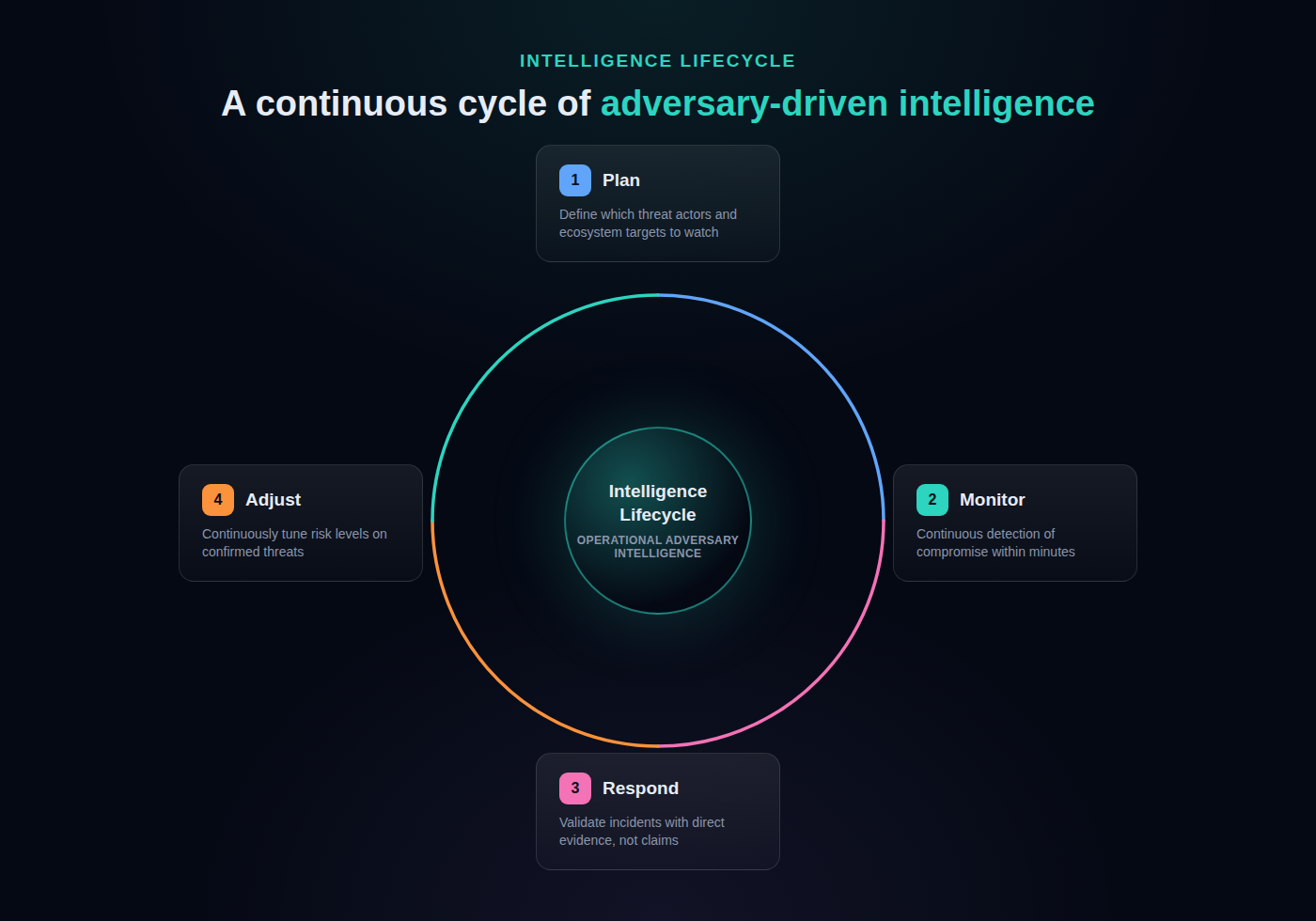

The HackNotice Intelligence Lifecycle
HackNotice supports the operational lifecycle of adversary intelligence through four continuous stages:
Identify  Collect Augment Verify
 Collect
HackNotice researchers continuously identify new breach sources — ransomware groups, hacker forums, and public and government disclosures — then collect data through automated and browser-based scraping, augment each event with translation, domain matching, and duplicate detection, and verify it before promoting it live.
Define the Scope of Intelligence Monitoring
Security teams begin by defining the organizations, vendors, domains, and user accounts that should be monitored across the adversary ecosystem. This establishes the monitoring scope for detecting compromise signals that may affect the organization or its supply chain.
Continuous Adversary Intelligence Collection
HackNotice continuously collects intelligence from the sources where threat actors operate, including ransomware leak sites, underground forums, breach datasets, infostealer malware logs, and criminal marketplaces. This monitoring enables security teams to detect compromise events affecting their organization and vendor ecosystem in near real time.
Intelligence Enrichment and Prioritization
Alerts are enriched with contextual intelligence including adversary attribution, threat actor activity, ransomware group involvement, and MITRE ATT&CK mappings. This helps security teams quickly understand the nature of the threat and determine the appropriate response.
Improve Security Posture Based on Intelligence Insights
Threat intelligence provides organizations with insight into how adversaries target their ecosystem. Security teams can use this intelligence to strengthen defenses, adjust vendor risk strategies, and improve incident response readiness.
Identify High-Risk Ecosystem Exposure
Organizations can monitor vendors, employees, and digital assets that may be targeted by adversaries. This enables security teams to extend visibility beyond internal systems and into the broader ecosystem where many attacks originate.
Early Detection of Compromise Signals
When new threat activity is identified, HackNotice surfaces alerts that may indicate exposed credentials, vendor breaches, ransomware incidents, or other compromise events requiring investigation.
Operational Security Workflows
HackNotice enables security teams to operationalize intelligence through built-in workflows that support investigation and response. These workflows may include vendor communication, incident follow-up, and automated vendor assessments to collect incident details when compromise events occur.
Strengthen Vendor Risk Programs
By continuously monitoring compromise signals and threat activity, organizations gain a clearer understanding of risk across their supply chain and can proactively strengthen vendor security requirements and monitoring practices.
A Continuous Intelligence Process
The HackNotice Intelligence Lifecycle is designed as a continuous process that evolves alongside the threat landscape.
As new adversary activity emerges, HackNotice continuously collects intelligence from 250+ ransomware groups and hundreds of hacker forums — indexing nearly a billion records a month across both ransomware incidents and leaked data — then enriches and verifies each event before it reaches your watchlist. Alerts are delivered by email, mobile push, or API, so security teams see activity an average of 70 days before it’s publicly disclosed.

Understanding the Technology Behind the Intelligence
HackNotice combines large-scale intelligence collection, automated analysis, and operational workflows to transform adversary activity into actionable security insights.
The next section explores how the platform collects, analyzes, and delivers this intelligence.
